Why you should b(r)other
January 28, 2026
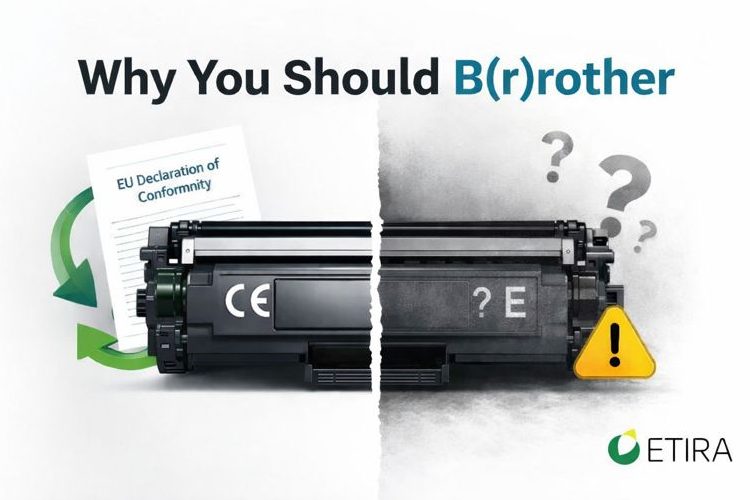
ETIRA was recently asked to assess a toner cartridge offered for sale on the European market as a compatible alternative for a Brother TN-2420 cartridge, intended for use in EU-market Brother printers. The product was marketed as suitable for European models and presented as compliant with applicable EU requirements. At first glance, it appeared unremarkable. A closer inspection, however, revealed serious concerns.

Physical examination showed markings consistent with a non-European cartridge model, partially obscured or altered before sale. In practical terms, a cartridge originally designed for use outside the European market had been re-identified and placed on sale in Europe as an EU-market equivalent. That single discrepancy is sufficient to trigger a cascade of legal and compliance failures.
Under European law, the ability to remanufacture or resell a product depends on the first sale doctrine, also known as the principle of exhaustion. Intellectual property rights are exhausted only when a product has been lawfully placed on the market within the European Economic Area by the rights holder or with their consent. Where that first lawful EU sale never occurred, those rights are not exhausted. The product cannot be legally remanufactured or resold in Europe.
In this case, the original cartridge was not placed on the European market by the OEM. As a result, any remanufacture or resale of that cartridge within the EU infringes the OEM’s intellectual property rights. However, the implications extend beyond IP law alone.
Because the original product was never placed on the EU market, it was never subject to EU conformity assessment. There is therefore no valid EU Declaration of Conformity supporting its sale in Europe. Any CE marking applied to the cartridge, or its packaging, cannot lawfully stand. When such a product is imported and sold in the EU, the importer is effectively declaring compliance for a market the product was never designed or tested for.
Under Regulation (EU) 2019/1020, that declaration transfers full responsibility to the importer, who becomes the manufacturer of record. The importer assumes legal liability for conformity, safety, and compliance. Where that declaration is false, market surveillance authorities are empowered to intervene, seize products, order withdrawals, and impose penalties.
While many OEMs actively enforce their intellectual property rights, enforcement across the sector is not uniform. Some rights holders pursue infringements aggressively, while others act selectively or focus their resources elsewhere. In ETIRA’s experience, the full range of enforcement options available to rights holders is not always exercised. This can create the impression in the market that certain practices are tolerated, even where they are not lawful.
That impression is misplaced. The absence of enforcement does not create permission, nor does it limit the legal options available to rights holders or authorities. Compliance obligations exist independently of enforcement patterns, and market surveillance authorities assess legality based on the law, not on past enforcement decisions.
Beyond IP and CE compliance, there is a further consequence that is often overlooked. Cartridges imported in this way frequently cannot be reused by European remanufacturers. They fall outside established reuse streams, are incompatible with local processes, or carry legal uncertainty that makes reuse impractical. In many cases, they are diverted into disposal or OEM recycling schemes that were never designed to absorb this volume.
The result is a perverse outcome. Products imported under the guise of competition increase waste, undermine legitimate remanufacturing, and shift environmental responsibility onto Europe. European businesses and consumers are left paying to manage products that should never have been placed on the market in the first place.
For ETIRA, this case is not about one cartridge or one OEM ecosystem. It is an illustration of how misused compliance markings, re-identification practices, and weak enforcement signals distort the market and damage the circular economy. When one rule is ignored, many others fall with it.
ETIRA will continue to identify such practices, support its members in escalating concerns, and work with OEMs and market surveillance authorities to ensure that European law is applied consistently. Compliance is not a technical detail. It is the foundation of fair competition, environmental responsibility, and trust in the European market.