ETIRA: Europe Needs Stronger Parcel Levies to Stop Illegal Cartridge Imports
December 16, 2025
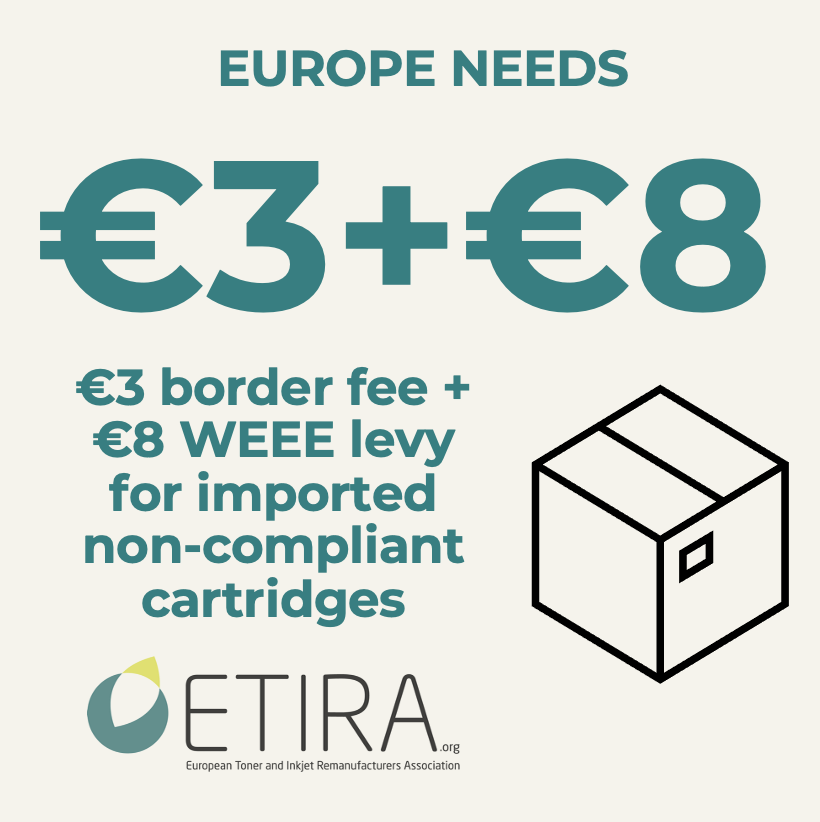
The European Union is preparing to introduce in 2026 a new €3 EU-wide handling fee on low-value imports, alongside a growing number of national charges in countries such as Italy and Romania. The measures are intended to curb the huge volume of small parcels entering the bloc, more than 90 per cent of which originate in China and which often bypass essential compliance checks.
ETIRA has welcomed the move as an essential acknowledgement that low-value parcels generate real costs, but warned that €3 alone is far too low to deter non-compliant imports of cheap, single-use cartridges. The association argues that restoring market balance requires a combined approach: a border handling fee, plus proper recovery of WEEE take-back and end-of-life costs currently absorbed by compliant European operators.
To illustrate the scale of that burden, ETIRA uses €8 as a realistic benchmark for the average cost of managing non-compliant cartridges at end of life. While a small inkjet cartridge may cost only a few cents to dispose of, a large 2kg toner cartridge can cost €14 or more. Across the mix of products entering Europe, the average cost borne by the compliant industry sits close to eight euros per cartridge.
A spokesperson for the association said,
“Low-value parcels are entering the EU at unprecedented scale, and a €3 handling fee is a step in the right direction. But €3 does not cover WEEE obligations or take-back costs. Restoring balance requires €3 at the border plus around €8 to cover the real end-of-life burden created by non-compliant cartridges. Without that, illegal and non-compliant imports will continue to shift costs onto compliant European businesses.”
The warning comes as EU companies increase pressure on Brussels to act more swiftly. Some national governments have already taken their own measures. Romania has proposed a fee of 25 lei, and Italy is preparing a parcel tax to shield domestic industries from unfair online competition. Retail groups have cautioned that a patchwork of national charges could undermine the single market.
Momentum for stricter parcel controls is also growing outside the EU. In the United Kingdom, the government announced in its 2025 Budget that it will abolish the existing de minimis exemption for low-value imports, which currently allows goods worth less than £135 to enter the country without customs duty. A formal consultation is now underway, with implementation planned by March 2029. UK industry federations have warned that the loophole is enabling a surge in cheap, non-compliant imports from Asia — concerns that closely mirror those raised by ETIRA in the European market.
ETIRA argues that the solution lies in harmonised EU rules combined with meaningful enforcement. Stronger customs checks, mandatory verification of authorised representatives, and alignment with WEEE and EPR producer registers are essential steps. Without them, the forthcoming Ecodesign framework for imaging equipment will struggle to deliver real environmental improvements.
“Europe is trying to build a circular economy, yet millions of new-build cartridges that do not comply with European standards are still slipping in under low-value thresholds every week,” ETIRA noted. “Recognising the problem with a €3 fee is a start, but only a combined approach that also recovers real WEEE and take-back costs will deliver lasting change,”
ETIRA will continue engaging with EU and national policymakers to ensure that parcel-levy reforms support Europe’s reuse industry and strengthen compliance across the imaging sector.