New EU Packaging Rules Take Effect
September 9, 2026
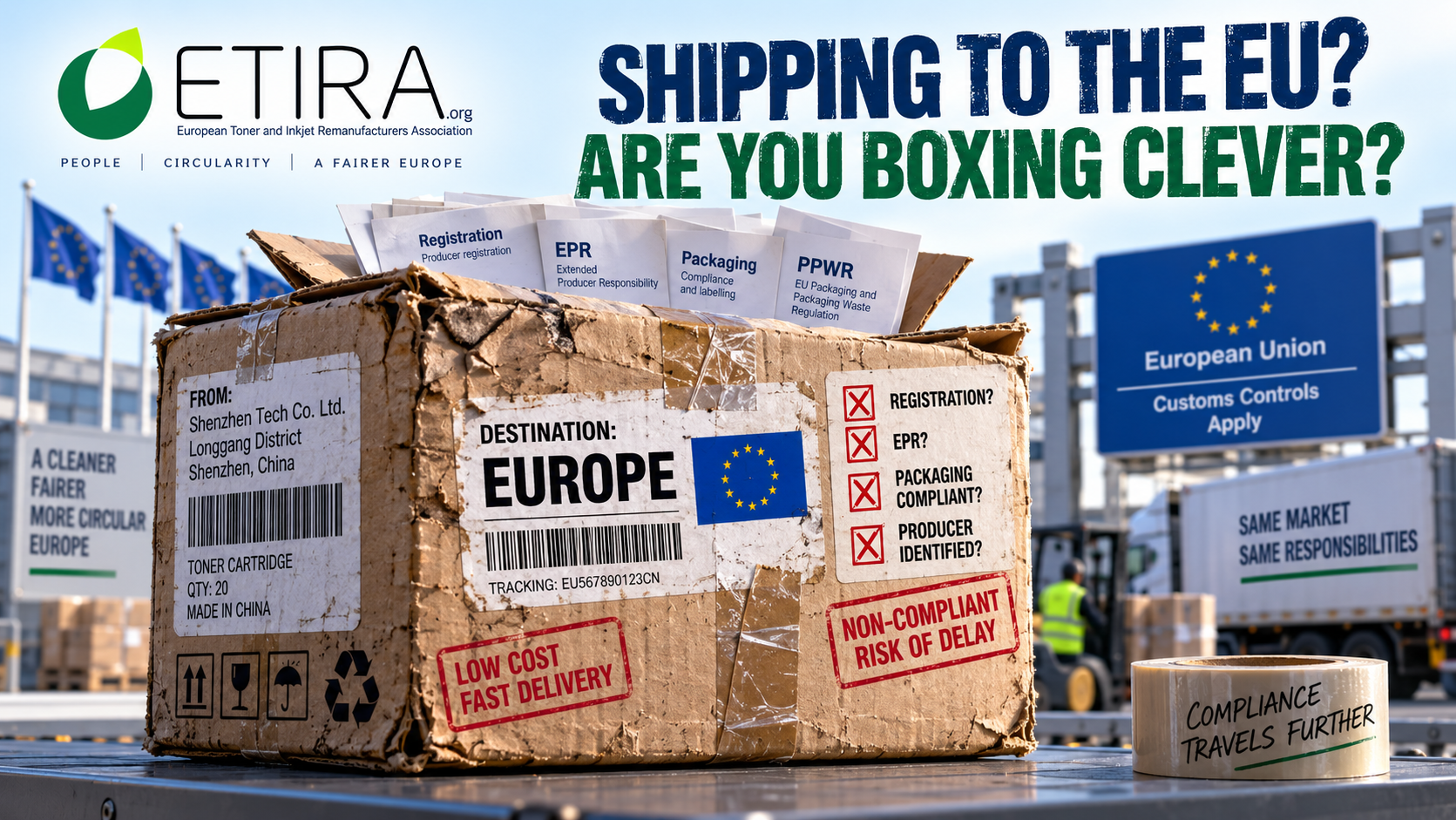
While many European businesses were taking their summer break, new EU packaging rules became applicable. ETIRA looks at what they could mean for the imaging supplies industry and businesses selling across Europe.
While many businesses were enjoying their summer holidays, another significant piece of European environmental legislation became applicable.
On 12 August 2026, the EU’s Packaging and Packaging Waste Regulation (PPWR), Regulation (EU) 2025/40, became applicable across the European Union, replacing the previous Packaging and Packaging Waste Directive.
The Regulation is intended to reduce packaging waste, improve recyclability and reuse, increase the use of recycled materials and strengthen producer responsibility. Many of its detailed requirements will be introduced progressively over the coming years.
For the imaging supplies industry, however, PPWR is about considerably more than designing a better cartridge box.
One issue in particular deserves the immediate attention of companies selling products across Europe: producer registration and Extended Producer Responsibility (EPR).
Selling Across Europe
Under the PPWR, producers are required to register in each Member State where they make packaging or packaged products available for the first time.
This could have significant implications for European businesses operating across the Single Market.
A remanufacturer selling packaged cartridges directly into several Member States may need to consider registration, reporting and EPR requirements in each of those countries. Depending on the company’s role and route to market, this could mean dealing with several different national registration and producer responsibility systems.
The precise responsibility will depend upon the supply chain and which business meets the Regulation’s definition of the producer. Selling through an independent distributor, for example, can create a different situation from selling directly to an end user in another Member State.
ETIRA therefore recommends that companies selling packaged products across borders review their current arrangements and establish where registration and EPR obligations may apply.
More Than the Cartridge Box
The PPWR covers packaging throughout its lifecycle.
For imaging supplies companies, that can include the packaging immediately surrounding a toner or inkjet cartridge as well as packaging used to group, transport and deliver products.
Over the coming years, businesses will also have to consider increasingly demanding requirements covering areas such as packaging minimisation, recyclability, recycled content and harmonised labelling.
The direction is clear: packaging is increasingly being treated as an integral part of the environmental impact of the product being placed on the European market.
Another Layer of Compliance
For Europe’s remanufacturing industry, PPWR does not exist in isolation.
European businesses already operate within an extensive framework of product and environmental legislation. Depending on their activities and products, this can include WEEE, Extended Producer Responsibility, REACH, CLP, product safety, packaging and waste legislation, together with associated registration, reporting, collection and end-of-life responsibilities.
Every one of these obligations carries an administrative and financial cost.
For smaller companies operating across several European markets, the cumulative burden can become substantial. A business supplying relatively modest quantities of packaged products across Europe could potentially find itself navigating numerous national registration, reporting and EPR systems.
ETIRA supports the environmental objectives behind the PPWR. However, implementation should also seek to minimise unnecessary administrative complexity, particularly for SMEs operating legitimately across the European Single Market.
What About Products Sold From Outside Europe?
The PPWR does not simply exempt producers because they are established outside the European Union.
Third-country businesses selling packaged products directly to European end users can also have producer responsibility obligations in the Member States into which they sell.
This is particularly important as ecommerce allows products to be sold directly from manufacturers and traders outside Europe to European consumers and businesses.
The challenge is therefore not simply whether European legislation applies. The challenge is ensuring that it is effectively enforced.
European manufacturers, remanufacturers, importers and distributors should not find themselves paying registration fees, EPR contributions and the administrative costs of compliance while competing products reach the same European customers without equivalent obligations being met.
Same Market, Same Responsibilities
ETIRA has consistently argued that environmental and product legislation must create a level playing field.
Companies established outside Europe should remain free to compete in the European market. But where they sell products into Europe, the same environmental and product responsibilities must be effectively applied and enforced.
The PPWR also introduces provisions intended to strengthen accountability for cross-border and online sales, including requirements affecting online platforms and the verification of producer registration.
ETIRA welcomes moves towards greater accountability but believes enforcement will determine whether the new framework succeeds.
If European businesses are required to register, report and contribute towards the environmental cost of packaging in every market they serve, equivalent requirements must be effectively enforced for all businesses supplying those markets, regardless of where they are established.
A More Accessible Single Market
There is also a wider issue for European policymakers to consider.
A Regulation designed to create more harmonised rules across the Single Market should ultimately make compliance easier to understand and administer, not require SMEs to navigate an unnecessarily fragmented landscape of national systems.
ETIRA believes greater harmonisation of registration, reporting and verification could reduce the administrative burden on compliant businesses while simultaneously making enforcement more effective.
A simple, accessible European system through which businesses, customers, online platforms and enforcement authorities could verify producer registrations across Member States would be a logical step towards that objective.
In the meantime, ETIRA encourages members selling packaged products across Europe to review their existing packaging registrations and EPR arrangements and seek specialist advice where necessary.
ETIRA will continue to monitor implementation of the PPWR and advocate for a system that supports the environmental objectives of the Regulation while ensuring fair competition, proportionate administration and equal enforcement across the European market.