If You Import or Sell Cartridges in the EU
February 11, 2026

This Compliance Checklist Is Your Starting Point
If your company imports, sells, distributes, or places printer cartridges on the EU market, compliance is not optional, and it is no longer something that can be treated as a box-ticking exercise.
EU enforcement is increasing, responsibilities are expanding, and misunderstandings around who is legally responsible remain widespread. The result? Too many businesses are exposed to fines, product seizures, forced withdrawals, and in serious cases, criminal liability, often without realising it.
To help address this, ETIRA has published a practical EU Imported Cartridges Compliance Checklist, designed as a clear starting point for anyone involved in placing cartridges on the EU market.
Why a checklist?
Because most compliance failures do not occur by intent but by assumption.
Common examples ETIRA encounters include:
- Importers assume compliance sits with the overseas supplier,
- Distributors believing obligations stop at logistics,
- Sellers misunderstanding of when CE marking is permitted,
- Companies are underestimating the reach of REACH, CLP, WEEE, and GPSR obligations.
Compliance is not a sliding scale. Like being pregnant, you either are or you are not. There is no such thing as being “a little bit compliant”.
In reality, legal responsibility lies with the company that places the product on the EU market, regardless of where it was manufactured or remanufactured.
What the checklist covers
The checklist sets out ten core compliance areas that apply to new and reused cartridges, including:
- EU presence and accountability,
- Manufacturer and importer identification,
- REACH obligations for chemicals and substances,
- Safety Data Sheets and documentation,
- Declarations of Conformity,
- WEEE registration and take-back obligations,
- Packaging compliance,
- Correct and lawful use of CE marking,
- Intellectual property and first-sale rules,
- The new General Product Safety Regulation (GPSR).
Each point explains what must be done and, crucially, what can happen if it is ignored; from border detention and sales bans to heavy fines and, for REACH breaches, potential imprisonment.
This makes the checklist not just informative, but operational.
Why this matters now
Non-compliant cartridges cannot be reused or remanufactured. They become waste.
Every such cartridge costs the European industry money to dispose of, removes reusable cores from the circular economy, and undermines compliant businesses that invest in doing things properly. At the same time, enforcement authorities are increasingly focused on traceability, documentation, and accountability — especially for imported products.
In short, cost does not reveal compliance. Verification does.
Who should use this checklist?
This checklist is relevant if you are:
- importing cartridges into the EU
- selling cartridges under your own brand,
- distributing products sourced outside the EU,
- operating online marketplaces or fulfilment models,
- remanufacturing or refurbishing cartridges for resale.
If you are involved at any point in placing cartridges on the EU market, this checklist is where you should start.
The EU Imported Cartridges Compliance Checklist is available now via ETIRA.
It is intended as a first step — a practical tool to help companies identify risks, ask the right questions, and avoid costly mistakes before enforcement does it for them.
Further guidance and deeper analysis will follow in upcoming ETIRA publications, but compliance always starts with understanding your obligations.
Tags
ComplianceETIRA
EU
Why you should b(r)other
January 28, 2026
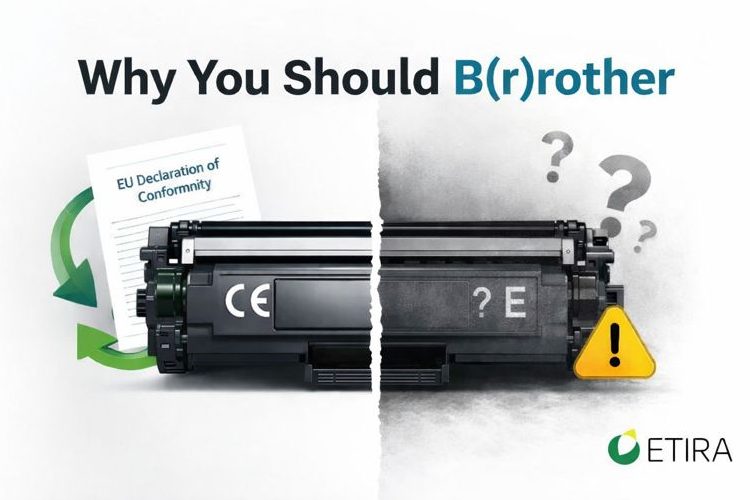
ETIRA was recently asked to assess a toner cartridge offered for sale on the European market as a compatible alternative for a Brother TN-2420 cartridge, intended for use in EU-market Brother printers. The product was marketed as suitable for European models and presented as compliant with applicable EU requirements. At first glance, it appeared unremarkable. A closer inspection, however, revealed serious concerns.

Physical examination showed markings consistent with a non-European cartridge model, partially obscured or altered before sale. In practical terms, a cartridge originally designed for use outside the European market had been re-identified and placed on sale in Europe as an EU-market equivalent. That single discrepancy is sufficient to trigger a cascade of legal and compliance failures.
Under European law, the ability to remanufacture or resell a product depends on the first sale doctrine, also known as the principle of exhaustion. Intellectual property rights are exhausted only when a product has been lawfully placed on the market within the European Economic Area by the rights holder or with their consent. Where that first lawful EU sale never occurred, those rights are not exhausted. The product cannot be legally remanufactured or resold in Europe.
In this case, the original cartridge was not placed on the European market by the OEM. As a result, any remanufacture or resale of that cartridge within the EU infringes the OEM’s intellectual property rights. However, the implications extend beyond IP law alone.
Because the original product was never placed on the EU market, it was never subject to EU conformity assessment. There is therefore no valid EU Declaration of Conformity supporting its sale in Europe. Any CE marking applied to the cartridge, or its packaging, cannot lawfully stand. When such a product is imported and sold in the EU, the importer is effectively declaring compliance for a market the product was never designed or tested for.
Under Regulation (EU) 2019/1020, that declaration transfers full responsibility to the importer, who becomes the manufacturer of record. The importer assumes legal liability for conformity, safety, and compliance. Where that declaration is false, market surveillance authorities are empowered to intervene, seize products, order withdrawals, and impose penalties.
While many OEMs actively enforce their intellectual property rights, enforcement across the sector is not uniform. Some rights holders pursue infringements aggressively, while others act selectively or focus their resources elsewhere. In ETIRA’s experience, the full range of enforcement options available to rights holders is not always exercised. This can create the impression in the market that certain practices are tolerated, even where they are not lawful.
That impression is misplaced. The absence of enforcement does not create permission, nor does it limit the legal options available to rights holders or authorities. Compliance obligations exist independently of enforcement patterns, and market surveillance authorities assess legality based on the law, not on past enforcement decisions.
Beyond IP and CE compliance, there is a further consequence that is often overlooked. Cartridges imported in this way frequently cannot be reused by European remanufacturers. They fall outside established reuse streams, are incompatible with local processes, or carry legal uncertainty that makes reuse impractical. In many cases, they are diverted into disposal or OEM recycling schemes that were never designed to absorb this volume.
The result is a perverse outcome. Products imported under the guise of competition increase waste, undermine legitimate remanufacturing, and shift environmental responsibility onto Europe. European businesses and consumers are left paying to manage products that should never have been placed on the market in the first place.
For ETIRA, this case is not about one cartridge or one OEM ecosystem. It is an illustration of how misused compliance markings, re-identification practices, and weak enforcement signals distort the market and damage the circular economy. When one rule is ignored, many others fall with it.
ETIRA will continue to identify such practices, support its members in escalating concerns, and work with OEMs and market surveillance authorities to ensure that European law is applied consistently. Compliance is not a technical detail. It is the foundation of fair competition, environmental responsibility, and trust in the European market.
Tags
CircularityCompliance
Governance
Integrity
ETIRA: Europe Needs Stronger Parcel Levies to Stop Illegal Cartridge Imports
December 16, 2025
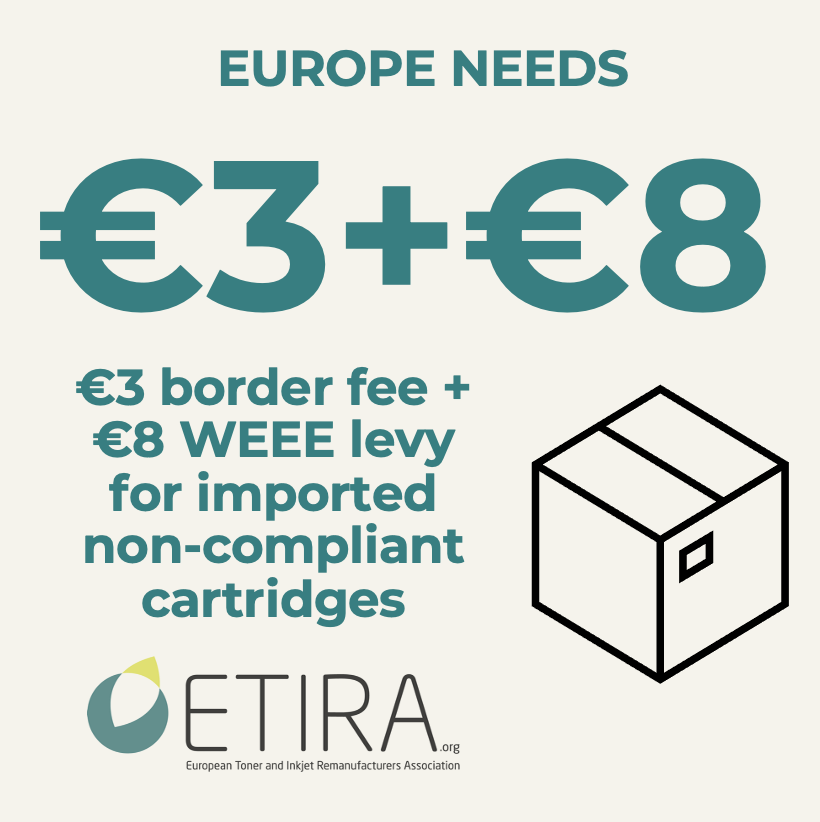
The European Union is preparing to introduce in 2026 a new €3 EU-wide handling fee on low-value imports, alongside a growing number of national charges in countries such as Italy and Romania. The measures are intended to curb the huge volume of small parcels entering the bloc, more than 90 per cent of which originate in China and which often bypass essential compliance checks.
ETIRA has welcomed the move as an essential acknowledgement that low-value parcels generate real costs, but warned that €3 alone is far too low to deter non-compliant imports of cheap, single-use cartridges. The association argues that restoring market balance requires a combined approach: a border handling fee, plus proper recovery of WEEE take-back and end-of-life costs currently absorbed by compliant European operators.
To illustrate the scale of that burden, ETIRA uses €8 as a realistic benchmark for the average cost of managing non-compliant cartridges at end of life. While a small inkjet cartridge may cost only a few cents to dispose of, a large 2kg toner cartridge can cost €14 or more. Across the mix of products entering Europe, the average cost borne by the compliant industry sits close to eight euros per cartridge.
A spokesperson for the association said,
“Low-value parcels are entering the EU at unprecedented scale, and a €3 handling fee is a step in the right direction. But €3 does not cover WEEE obligations or take-back costs. Restoring balance requires €3 at the border plus around €8 to cover the real end-of-life burden created by non-compliant cartridges. Without that, illegal and non-compliant imports will continue to shift costs onto compliant European businesses.”
The warning comes as EU companies increase pressure on Brussels to act more swiftly. Some national governments have already taken their own measures. Romania has proposed a fee of 25 lei, and Italy is preparing a parcel tax to shield domestic industries from unfair online competition. Retail groups have cautioned that a patchwork of national charges could undermine the single market.
Momentum for stricter parcel controls is also growing outside the EU. In the United Kingdom, the government announced in its 2025 Budget that it will abolish the existing de minimis exemption for low-value imports, which currently allows goods worth less than £135 to enter the country without customs duty. A formal consultation is now underway, with implementation planned by March 2029. UK industry federations have warned that the loophole is enabling a surge in cheap, non-compliant imports from Asia — concerns that closely mirror those raised by ETIRA in the European market.
ETIRA argues that the solution lies in harmonised EU rules combined with meaningful enforcement. Stronger customs checks, mandatory verification of authorised representatives, and alignment with WEEE and EPR producer registers are essential steps. Without them, the forthcoming Ecodesign framework for imaging equipment will struggle to deliver real environmental improvements.
“Europe is trying to build a circular economy, yet millions of new-build cartridges that do not comply with European standards are still slipping in under low-value thresholds every week,” ETIRA noted. “Recognising the problem with a €3 fee is a start, but only a combined approach that also recovers real WEEE and take-back costs will deliver lasting change,”
ETIRA will continue engaging with EU and national policymakers to ensure that parcel-levy reforms support Europe’s reuse industry and strengthen compliance across the imaging sector.
Tags
ComplianceLevy
WEEE
ETIRA’s 2025 Vision: Tackling Non-Compliance and Championing Sustainability
January 13, 2025

As Europe’s office imaging market enters 2025, ETIRA calls for more vigorous enforcement and a unified push towards sustainable, compliant remanufacturing.
The European office imaging market faces a pivotal year in 2025, marked as a tipping point where rising economic pressures and tightening regulations reshape the industry. The European Toner and Inkjet Remanufacturers Association (ETIRA) is intensifying its efforts to tackle long-standing challenges and seize emerging opportunities for its members.
“2025 will test our industry’s resilience,” said Javier Martinez, ETIRA president. “But it’s also a chance to double down on compliance, sustainability, and fair competition.”
The Compliance Battle Intensifies
A top priority for ETIRA is addressing the ongoing influx of non-compliant imports. Despite years of advocacy, cartridges failing to meet EU standards—lacking CE markings, WEEE registration, or REACH compliance—continue to dominate market share, often entering through online platforms.
ETIRA highlights a growing EU-wide effort to hold online marketplaces accountable. An Online Sales Compliance team at the European Parliament is actively working to make platforms fully responsible for the products sold. ETIRA is engaging with this team to drive progress and align strategies.
“The unchecked flow of non-compliant imports undermines everything we’re working towards,” said Martinez. “2025 must be the year we see stronger enforcement and penalties across all EU member states.”
ETIRA urges greater collaboration among national authorities, industry stakeholders, and EU institutions like ECHA (REACH) and Market Surveillance Authorities (MSAs) to eliminate regulatory loopholes and penalize offenders.
Sustainability as a Growth Driver
With the EU’s circular economy agenda gaining momentum, 2025 represents a significant opportunity for compliant remanufacturers. ETIRA is championing remanufactured cartridges as cost-effective, environmentally responsible alternatives perfectly aligned with EU sustainability goals.
“The demand for sustainable solutions is growing, and remanufactured cartridges are ideally positioned to meet that demand,” said Martinez.
ETIRA strongly advocates for the inclusion of product criteria similar to those envisioned for Digital Product Passports (DPPs). These criteria would provide essential information about a product’s compliance, sustainability credentials, and remanufacturing history, empowering buyers to make informed choices.
Economic Challenges in 2025
The backdrop for ETIRA’s efforts is a challenging economic environment. Corporate bankruptcies surged in 2024, and the new year brings heightened inflation, rising energy costs, and interest rates.
These pressures are influencing office imaging sector trends. Businesses are increasingly opting for remanufactured cartridges as value-driven alternatives while delaying investments in new printers, relying instead on existing equipment.
“This environment reinforces the need for high-quality, compliant remanufactured consumables,” said Martinez. “But it also underscores the importance of fair competition—non-compliant products hurt both the environment and the economy.”
Looking Forward: ETIRA’s 2025 Agenda
ETIRA’s roadmap for 2025 includes:
- Advocacy for Fair Competition: Collaborating with EU institutions to strengthen enforcement against non-compliant imports and create a level playing field.
- Promoting Sustainability: Raising awareness about the benefits of remanufactured cartridges in achieving EU circular economy targets.
- Digital Product Passport-Type Information: Championing DPP-like product information to enhance market transparency and reward compliant businesses.
- Supporting Members: Providing resources and advocacy to help remanufacturers navigate economic and regulatory challenges.
A Vision for the Future
As Europe’s office imaging market adapts to the complexities of 2025, ETIRA remains committed to protecting and promoting its members’ interests. The association aims to secure a stronger, more competitive future by prioritising compliance, sustainability, and collaboration.
“2025 is a year of action,” said Martinez. “If we work together, we can overcome challenges and ensure a thriving, sustainable remanufacturing industry.”
Tags
2025circular economy
Compliance
ETIRA: New Non-OEM Cartridges – A Threat to Compliance, Sustainability, and Public Health
November 28, 2024

Recent compliance checks reveal widespread violations of EU regulations, endangering the environment and the health of citizens.
BRUSSELS/BREDA – 28 November 2024—The European Toner and Inkjet Remanufacturers Association (ETIRA) has issued an urgent warning to European buyers: new non-OEM cartridges are high-risk and often blatantly illegal. ETIRA investigations revealed that 75% of these products fail to meet EU standards, with only 8% fully compliant. In contrast, remanufactured OEM cartridges performed significantly better, with 85% meeting most or all regulations.
Key Findings from ETIRA’s Compliance Checks
From July to November 2024, ETIRA reviewed approx. 50 new non-OEM toner and remanufactured OEM cartridges across Germany, France, the Czech Republic, Romania, Spain, and Italy. Products were sourced from major suppliers, including Plate Bürobedarf, Kaut-Bullinger, Ribbex, Backhausen, HQ-Patronen GmbH, TonerPartner GmbH, “Stefan Brogno tintendienst.de,” Tonerdumping., Hispamicro, Muchocartucho, Inkcloud, Inforpor (Xerox), Linsed, Life 365 Italy, Alphaink, Ecostore, Buffetti, TS Bohemia, Mall/Allegro, and Compatible cz.
Key results:
New Non-OEM Cartridges:
- 75% failed basic documentary compliance checks regarding permanent CE and Wheelie bin marks, entry in the national WEEE registry, and, where required, packaging registry and Declaration of Conformity.
- Packaging frequently lacked accurate supplier information, or only listed suppliers outside the EU.
- Often carried the CE logo without meeting the EU standards it stands for
- Instances of false labelling as being a remanufactured OEM product
One of the most troubling findings was the non-compliance of products purchased from Ribbex, a prominent supplier in Germany. Cartridges in boxes labelled as “Rebuilt” and “Made in Germany” were, in fact, new non-OEM cartridges imported from SE Asia by a Portuguese entity.
Remanufactured OEM Cartridges:
85% were relatively compliant, with only one supplier missing from the national WEEE registry.
Hazardous Practices Continue
These findings echo ETIRA’s product tests performed in the past, which showed new non-OEM toner cartridges often failed hazardous chemical checks, including decaBDE and toner emissions. These products endanger public health, the environment, and legitimate businesses.
ETIRA Demands Stronger Enforcement
ETIRA is taking decisive action by reporting violations to national market surveillance authorities and exposing buyers of non-compliant products.
“The EU’s circular economy demands stronger enforcement against hazardous chemicals and illegal goods,” said Javier Martinez, ETIRA President. “Over 30% of the market is illegal, threatening fair competition, environmental care, and consumer health—urgent action is essential.”
What Buyers Should Know
ETIRA reminds buyers and suppliers that non-OEM cartridges must comply with REACH, WEEE, and other EU directives. Importers are responsible for ensuring compliance, and failure to do so risks legal penalties.
Tags
ComplianceBeware of Illegal Printer Cartridges:
May 28, 2024

Beware of Illegal Printer Cartridges: A Call to Action from ETIRA- ETIRA model protest letter
At the recent The Recycler Live conference, Javier Martinez brought to light a pressing issue facing our industry: the prevalence in the EU market of non-OEM newbuilt printer cartridges that fail to comply with EU regulations. Javier Martínez presented eye-opening research and a stark warning to consumers and industry professionals alike.
The Scope of the Problem
ETIRA’s research reveals that one-third of printer cartridges sold in Europe are non-compliant with EU standards. These newbuilt cartridges, often manufactured in China, lack proper labelling and safety information, making them both illegal and potentially hazardous. The environmental impact is staggering, with these non-compliant cartridges contributing to 420,000 tons of e-waste annually in Europe alone. Moreover, they are responsible for causing early damage to 20% of printers, exacerbating the e-waste problem.
Legal and Environmental Hazards
These newbuilt non-OEM cartridges do not meet critical EU regulations such as CE marking, WEEE, RoHS, and REACH. They often omit essential labels like the waste bin icon, misleading consumers about the appropriate disposal methods and increasing environmental risks. By avoiding these compliance measures, manufacturers reduce costs but at the expense of consumer safety and environmental health.
The Importance of Consumer Education
Educating consumers is crucial in distinguishing between legal and illegal cartridges. ETIRA recommends remanufactured OEM cartridges, particularly those made in Europe, as the best legal and environmentally friendly option. These cartridges comply with all EU regulations and offer significant environmental benefits. By shifting to remanufactured cartridges, we can reduce CO2 emissions by up to 45-60% and lower consumer costs by as much as 60%.
Taking Action
ETIRA calls for increased vigilance and regulatory enforcement to combat the sale of these illegal cartridges. Consumers and businesses should demand proper documentation and report any non-compliant products to authorities. ETIRA has a model letter, available upon request, that members may send to public bodies, to insist that public tenders comply with all EU legal requirements. By ensuring that the cartridges we purchase and use are legal, we can protect our environment and promote sustainable practices within our industry.
Conclusion
The findings underscore the urgent need for regulatory compliance and industry and consumer awareness. The proliferation of illegal, non-compliant newbuild printer cartridges poses significant environmental and public health risks. We can drive positive change in the industry by choosing remanufactured OEM cartridges and supporting compliant practices. ETIRA remains committed to advocating for a safer, more sustainable future in the toner and inkjet remanufacturing sector.
Together, we can make a difference. Let’s act now to ensure the cartridges we use are safe, legal, and environmentally friendly. For more information and to stay updated on our initiatives, visit our website at etira.org.