EU Customs Update
May 8, 2026
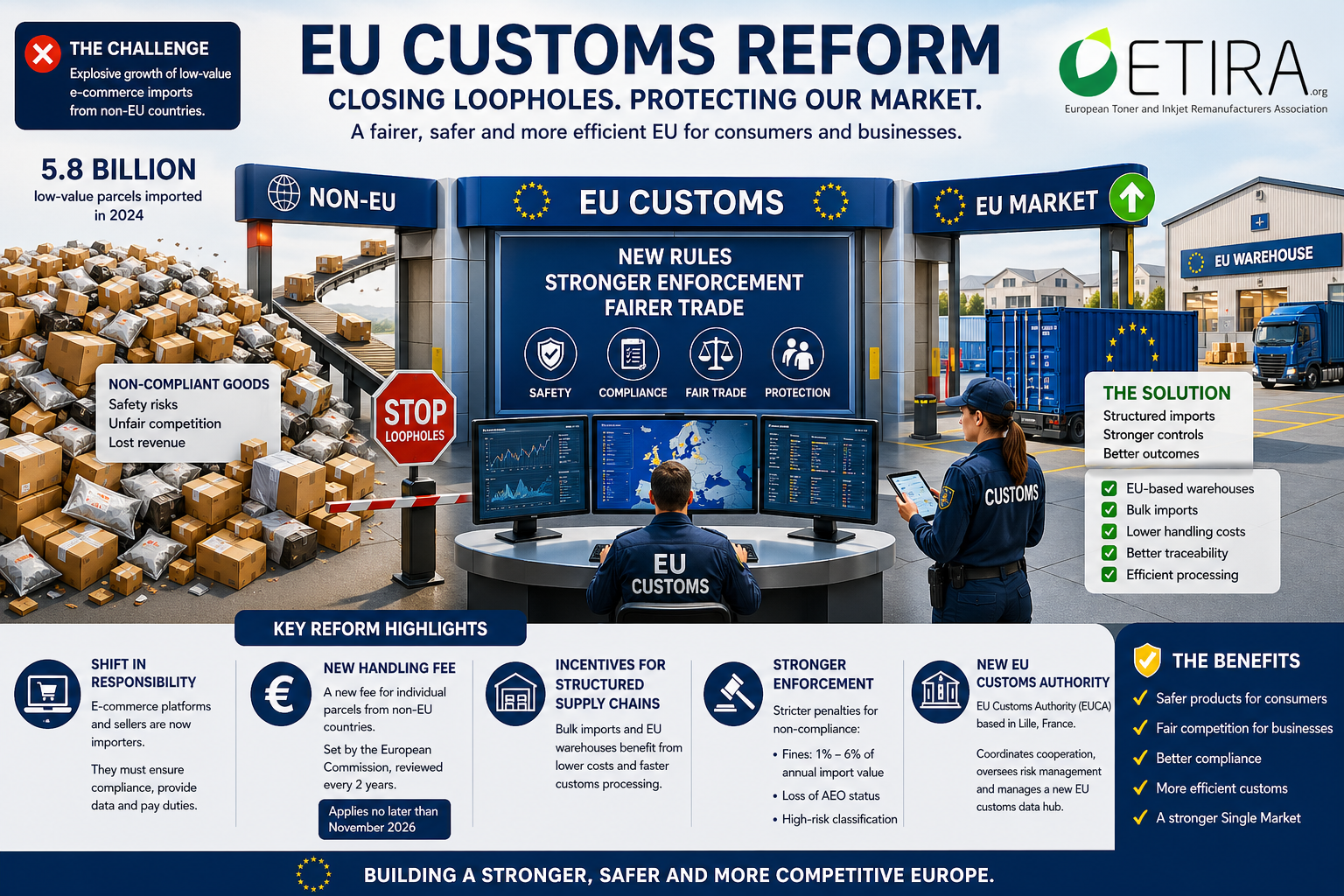
EU Customs Reform Targets Non-Compliant Imports and E-Commerce Loopholes
New rules shift responsibility to platforms and introduce stricter enforcement tools across the EU market
A provisional agreement between the European Parliament and the Council marks a significant step forward in the reform of the Union Customs Code, with a strong focus on addressing the rapid growth of e-commerce imports, product safety, and enforcement efficiency.
The reform responds to a fundamental challenge: the sheer volume of low-value parcels entering the EU from non-EU countries. In 2024 alone, an estimated 5.8 billion such parcels were imported, placing increasing pressure on customs authorities and raising concerns about compliance with EU regulations.
A shift in responsibility
One of the most important changes is the redefinition of responsibility.
Under the new rules, e-commerce platforms and sellers facilitating distance sales into the EU will be treated as importers. This means they will be required to:
- ensure goods comply with EU legislation
- provide full customs data
- pay or guarantee applicable duties and fees
This measure aims to close long-standing loopholes that have allowed non-compliant goods to enter the EU market via complex or opaque supply chains.
New handling fee for individual parcels
A new handling fee will be introduced for goods shipped directly from non-EU countries to EU consumers. The objective is to reflect the real cost of processing the growing number of individual parcels.
The fee will:
- be set by the European Commission
- be reviewed every two years
- apply no later than November 2026
Importantly, the fee will be charged to the responsible economic operator, not directly to consumers.
Incentives for structured supply chains
The reform also encourages the use of EU-based warehouses and bulk imports.
Goods imported in larger consignments and distributed within the EU will benefit from:
- lower handling costs
- more efficient customs processing
This approach supports better traceability and enforcement, while discouraging fragmented, high-volume parcel shipments that are harder to control.
Stronger enforcement and penalties
Companies that repeatedly fail to comply with EU rules will face stricter consequences, including:
- fines ranging from 1% to 6% of annual import value
- loss of trusted trader or AEO status
- classification as high-risk operators
These measures signal a clear shift towards more robust enforcement across the single market.
A new EU Customs Authority
The reform establishes a new EU Customs Authority (EUCA), to be based in Lille, France.
The Authority will:
- coordinate customs cooperation across member states
- oversee risk management
- manage a new EU customs data hub
The data hub will replace over 100 existing IT systems and aims to provide a real-time, integrated overview of goods entering the EU.
ETIRA perspective
For ETIRA, the reform represents an important recognition of the challenges posed by non-compliant imports and fragmented supply chains.
The shift of responsibility to platforms, combined with stronger enforcement tools, has the potential to:
- improve product compliance
- create fairer competition for European businesses
- reduce the flow of non-compliant consumables entering the market
However, effective implementation will be critical. Ensuring that high-risk product categories, including printer consumables, are properly monitored and enforced remains essential.
The agreement now awaits formal approval by the European Parliament and the Council before entering into force.
Tags
ComplianceCustoms
EU
If You Import or Sell Cartridges in the EU
February 11, 2026

This Compliance Checklist Is Your Starting Point
If your company imports, sells, distributes, or places printer cartridges on the EU market, compliance is not optional, and it is no longer something that can be treated as a box-ticking exercise.
EU enforcement is increasing, responsibilities are expanding, and misunderstandings around who is legally responsible remain widespread. The result? Too many businesses are exposed to fines, product seizures, forced withdrawals, and in serious cases, criminal liability, often without realising it.
To help address this, ETIRA has published a practical EU Imported Cartridges Compliance Checklist, designed as a clear starting point for anyone involved in placing cartridges on the EU market.
Why a checklist?
Because most compliance failures do not occur by intent but by assumption.
Common examples ETIRA encounters include:
- Importers assume compliance sits with the overseas supplier,
- Distributors believing obligations stop at logistics,
- Sellers misunderstanding of when CE marking is permitted,
- Companies are underestimating the reach of REACH, CLP, WEEE, and GPSR obligations.
Compliance is not a sliding scale. Like being pregnant, you either are or you are not. There is no such thing as being “a little bit compliant”.
In reality, legal responsibility lies with the company that places the product on the EU market, regardless of where it was manufactured or remanufactured.
What the checklist covers
The checklist sets out ten core compliance areas that apply to new and reused cartridges, including:
- EU presence and accountability,
- Manufacturer and importer identification,
- REACH obligations for chemicals and substances,
- Safety Data Sheets and documentation,
- Declarations of Conformity,
- WEEE registration and take-back obligations,
- Packaging compliance,
- Correct and lawful use of CE marking,
- Intellectual property and first-sale rules,
- The new General Product Safety Regulation (GPSR).
Each point explains what must be done and, crucially, what can happen if it is ignored; from border detention and sales bans to heavy fines and, for REACH breaches, potential imprisonment.
This makes the checklist not just informative, but operational.
Why this matters now
Non-compliant cartridges cannot be reused or remanufactured. They become waste.
Every such cartridge costs the European industry money to dispose of, removes reusable cores from the circular economy, and undermines compliant businesses that invest in doing things properly. At the same time, enforcement authorities are increasingly focused on traceability, documentation, and accountability — especially for imported products.
In short, cost does not reveal compliance. Verification does.
Who should use this checklist?
This checklist is relevant if you are:
- importing cartridges into the EU
- selling cartridges under your own brand,
- distributing products sourced outside the EU,
- operating online marketplaces or fulfilment models,
- remanufacturing or refurbishing cartridges for resale.
If you are involved at any point in placing cartridges on the EU market, this checklist is where you should start.
The EU Imported Cartridges Compliance Checklist is available now via ETIRA.
It is intended as a first step — a practical tool to help companies identify risks, ask the right questions, and avoid costly mistakes before enforcement does it for them.
Further guidance and deeper analysis will follow in upcoming ETIRA publications, but compliance always starts with understanding your obligations.
Tags
ComplianceETIRA
EU
New Ecodesign Proposals Unveiled
February 29, 2024

 The European Union’s Joint Research Centre (JRC) has introduced ambitious ecodesign proposals to enhance the sustainability of printers and cartridges significantly. This initiative represents a pivotal shift towards mandatory regulatory measures, departing from the voluntary agreements that have characterised the sector since 2015. The JRC’s Preparatory Study outlines a comprehensive strategy focused on extending product lifespans, improving material efficiency, and fostering a circular economy.
Key proposals include increasing the durability and reparability of printers, setting mandatory page yield requirements for cartridges, and promoting the use of remanufactured cartridges. Additionally, the JRC advocates for optimising energy savings, paper consumption, and the incorporation of post-consumer recycled plastic in printer manufacturing.
ETIRA President Javier Martinez welcomed the proposals, highlighting their alignment with the EU’s Green Deal objectives and their potential to reduce the environmental footprint of printing significantly. As the EU prepares to translate these findings into draft regulation, ETIRA commits to collaborating with stakeholders to ensure these positive advancements are realised.
You can download the JRC Report here.
Tags
EcolabelEU
JRC
February 2018: EU-commissioned study on cartridge market clearly concludes: more regulatory action is needed to promote cartridge reuse
March 26, 2019

 The EU’s “Study on the implementation of product design requirements set out in Article 4 of the WEEE Directive – The case of re-usability of printer cartridges” came out in late February 2018. It found that the cartridge market is very competitive, but the regulatory environment is not well suited to promoting reuse of products or encouraging dematerialisation and greater material efficiency. Significant alterations are proposed. The study writers promote using the Extended Producer Responsibility (EPR) as key to enhancing overall cartridge re-use.
Re. market data, they say that clones represent 5% of toner and inkjet markets respectively (which seems a serious underestimate). On the OEM’s Voluntary Agreement Imaging Equipment, the study says that its data shows the VA does not promote cartridge reuse. The study suggests to revise the VA, and include parameters on lower emissions of printing. The car industry has examples of such mandatory CO2 reduction targets. Reducing cartridge complexity (clever chips !) can be one of the ways to do that. On the Ecolabel, the study supports developing an EU Ecolabel criteria for remanufactured cartridges (as requested by ETIRA).
The study identified concerns and corresponding actions as follows:
- Creating a level playing field for the new and re-use/second-hand markets.
- Consolidating patent holder and OEM protection and second user rights
- Improving design for reuse, recycling and recovery
- Ensuring reused cartridge performance.
- Improving re-use performance disclosure.
To improve the market situation for both legitimate new and reused cartridges, a range of measures is proposed for consideration:
- Addressing the issue of ‘rogue clone’ imports
- Ensuring reuse agents do not misrepresent reused units as OEM products.
- Improving access to cartridge design and consumables specifications
- Revising the EU GPP criteria to address ‘remanufactured and refilled cartridges.
- Improving user information on all cartridge packaging to reveal true performance.
- Creating a rating system for cartridge quality (‘failure rate’) matched to user expectations.
- Rationalising acceptable phrases to be used to describe new and reused cartridges.
- Reviewing the Voluntary Agreement so that data on rates of take-back, re-use, recycling and other recovery operations is routinely collected and published.
- Expanding the scope of actions by producers of cartridges to promote and support the reuse option as an alternative to take-back.
In 2016/2017, ETIRA had provided substantial input to the writers of the study. We are glad to see that it now identifies current OEM market behaviour as not contributing to the promotion of cartridge reuse, and takes on board several of our recommendations to address this problem. We will now reach out to regulators to put this into action!