EU Parcel Levy Marks First Step Towards Fairer Competition
July 22, 2026

New €3 customs levy on low-value imports signals a broader shift towards stronger customs enforcement and greater supply chain accountability across Europe.
On 1 July 2026, the European Union introduced a temporary €3 customs levy on low-value parcels valued at €150 or less entering the EU from third countries.
While the levy is expected to increase the cost of many direct-to-consumer imports, ETIRA believes its greatest significance lies elsewhere. It represents the first practical step towards a wider reform of the EU customs system and a stronger focus on ensuring that products entering the European market comply with European legislation.
For many years, ETIRA has argued that European remanufacturers, distributors and compliant importers have faced an uneven competitive environment. Businesses placing products on the EU market must meet obligations under legislation, including WEEE, Extended Producer Responsibility (EPR), REACH, CLP and other product and environmental regulations. These requirements create genuine compliance costs that are not always reflected in the price of products imported directly through low-value parcel channels.
The new levy does not replace these obligations, nor does it remove the competitive advantage enjoyed by some low-cost imports. However, it begins to address one element of the imbalance while supporting customs authorities as wider reforms are introduced.
For the imaging supplies industry, the measure is particularly relevant. The economics of direct-to-consumer imports of low-cost compatible cartridges may begin to change, especially as customs authorities increase their focus on traceability, product compliance and supply chain accountability.
The levy should therefore be viewed as part of a much broader direction of travel. Alongside reforms to the Union Customs Code, new product safety requirements, revised CLP rules, Ecodesign legislation and future Digital Product Passports, the European Union is steadily building a regulatory framework based on verifiable traceability and more consistent enforcement.
ETIRA welcomes this first step but believes further progress is needed. A level playing field requires not only effective customs controls but also consistent enforcement of existing legislation across all products entering the European Single Market.
The association will continue to work with European institutions and national authorities to promote policies that support fair competition, encourage remanufacturing, and strengthen the circular economy while ensuring that all market participants operate under the same regulatory framework.
Tags
ComplianceCustoms
Imports
EU Customs Update
May 8, 2026
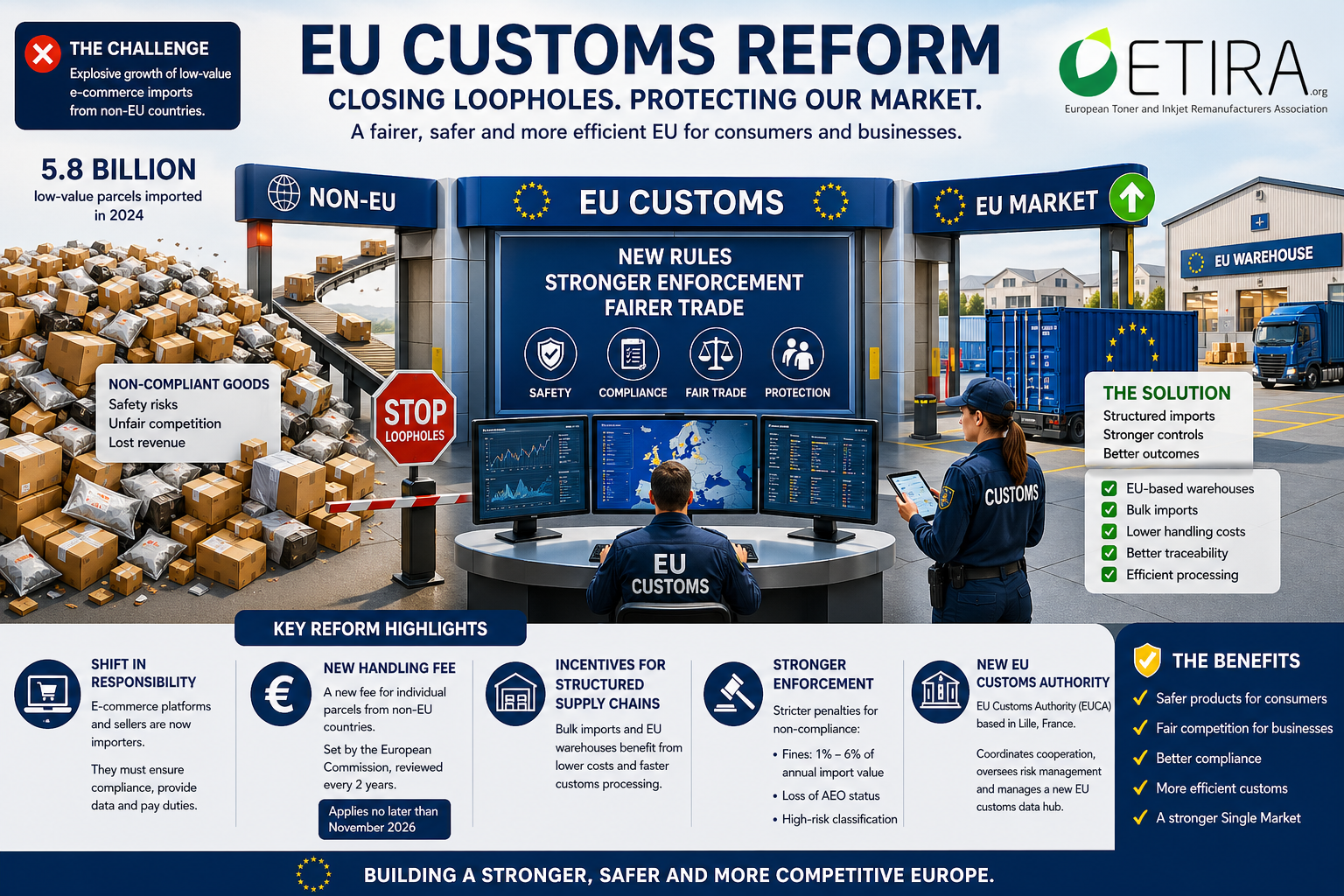
EU Customs Reform Targets Non-Compliant Imports and E-Commerce Loopholes
New rules shift responsibility to platforms and introduce stricter enforcement tools across the EU market
A provisional agreement between the European Parliament and the Council marks a significant step forward in the reform of the Union Customs Code, with a strong focus on addressing the rapid growth of e-commerce imports, product safety, and enforcement efficiency.
The reform responds to a fundamental challenge: the sheer volume of low-value parcels entering the EU from non-EU countries. In 2024 alone, an estimated 5.8 billion such parcels were imported, placing increasing pressure on customs authorities and raising concerns about compliance with EU regulations.
A shift in responsibility
One of the most important changes is the redefinition of responsibility.
Under the new rules, e-commerce platforms and sellers facilitating distance sales into the EU will be treated as importers. This means they will be required to:
- ensure goods comply with EU legislation
- provide full customs data
- pay or guarantee applicable duties and fees
This measure aims to close long-standing loopholes that have allowed non-compliant goods to enter the EU market via complex or opaque supply chains.
New handling fee for individual parcels
A new handling fee will be introduced for goods shipped directly from non-EU countries to EU consumers. The objective is to reflect the real cost of processing the growing number of individual parcels.
The fee will:
- be set by the European Commission
- be reviewed every two years
- apply no later than November 2026
Importantly, the fee will be charged to the responsible economic operator, not directly to consumers.
Incentives for structured supply chains
The reform also encourages the use of EU-based warehouses and bulk imports.
Goods imported in larger consignments and distributed within the EU will benefit from:
- lower handling costs
- more efficient customs processing
This approach supports better traceability and enforcement, while discouraging fragmented, high-volume parcel shipments that are harder to control.
Stronger enforcement and penalties
Companies that repeatedly fail to comply with EU rules will face stricter consequences, including:
- fines ranging from 1% to 6% of annual import value
- loss of trusted trader or AEO status
- classification as high-risk operators
These measures signal a clear shift towards more robust enforcement across the single market.
A new EU Customs Authority
The reform establishes a new EU Customs Authority (EUCA), to be based in Lille, France.
The Authority will:
- coordinate customs cooperation across member states
- oversee risk management
- manage a new EU customs data hub
The data hub will replace over 100 existing IT systems and aims to provide a real-time, integrated overview of goods entering the EU.
ETIRA perspective
For ETIRA, the reform represents an important recognition of the challenges posed by non-compliant imports and fragmented supply chains.
The shift of responsibility to platforms, combined with stronger enforcement tools, has the potential to:
- improve product compliance
- create fairer competition for European businesses
- reduce the flow of non-compliant consumables entering the market
However, effective implementation will be critical. Ensuring that high-risk product categories, including printer consumables, are properly monitored and enforced remains essential.
The agreement now awaits formal approval by the European Parliament and the Council before entering into force.