EU Parcel Levy Marks First Step Towards Fairer Competition
July 22, 2026

New €3 customs levy on low-value imports signals a broader shift towards stronger customs enforcement and greater supply chain accountability across Europe.
On 1 July 2026, the European Union introduced a temporary €3 customs levy on low-value parcels valued at €150 or less entering the EU from third countries.
While the levy is expected to increase the cost of many direct-to-consumer imports, ETIRA believes its greatest significance lies elsewhere. It represents the first practical step towards a wider reform of the EU customs system and a stronger focus on ensuring that products entering the European market comply with European legislation.
For many years, ETIRA has argued that European remanufacturers, distributors and compliant importers have faced an uneven competitive environment. Businesses placing products on the EU market must meet obligations under legislation, including WEEE, Extended Producer Responsibility (EPR), REACH, CLP and other product and environmental regulations. These requirements create genuine compliance costs that are not always reflected in the price of products imported directly through low-value parcel channels.
The new levy does not replace these obligations, nor does it remove the competitive advantage enjoyed by some low-cost imports. However, it begins to address one element of the imbalance while supporting customs authorities as wider reforms are introduced.
For the imaging supplies industry, the measure is particularly relevant. The economics of direct-to-consumer imports of low-cost compatible cartridges may begin to change, especially as customs authorities increase their focus on traceability, product compliance and supply chain accountability.
The levy should therefore be viewed as part of a much broader direction of travel. Alongside reforms to the Union Customs Code, new product safety requirements, revised CLP rules, Ecodesign legislation and future Digital Product Passports, the European Union is steadily building a regulatory framework based on verifiable traceability and more consistent enforcement.
ETIRA welcomes this first step but believes further progress is needed. A level playing field requires not only effective customs controls but also consistent enforcement of existing legislation across all products entering the European Single Market.
The association will continue to work with European institutions and national authorities to promote policies that support fair competition, encourage remanufacturing, and strengthen the circular economy while ensuring that all market participants operate under the same regulatory framework.
Tags
ComplianceCustoms
Imports
CLP Changes Ahead
June 24, 2026
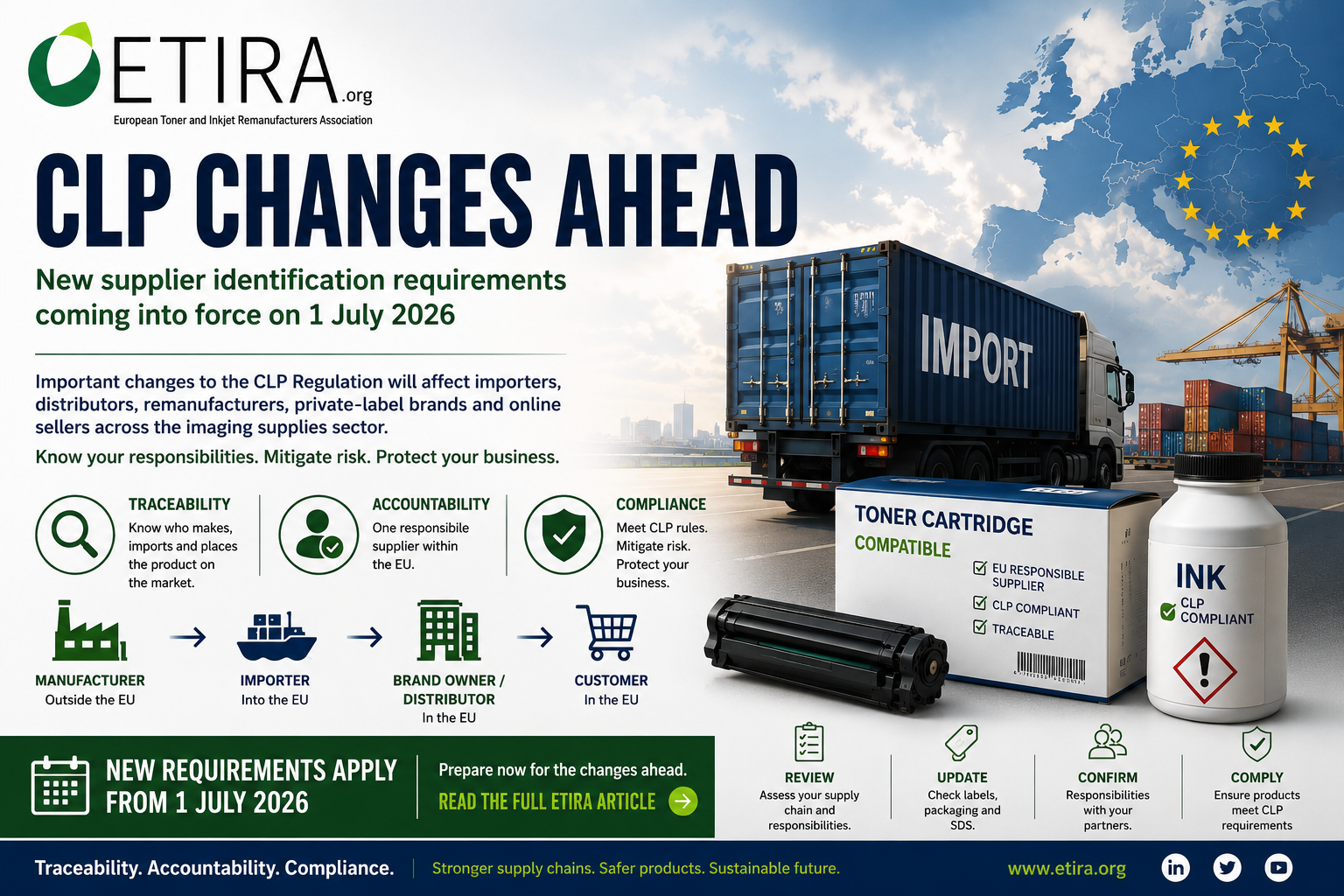
New supplier identification requirements coming into force on 1 July 2026 could have significant implications for cartridge importers, distributors, remanufacturers, private-label brands, and online sellers. ETIRA examines what the revised CLP Regulation may mean for the imaging supplies industry and the steps businesses should be taking now.
New supplier identification requirements coming into force on 1 July 2026 reinforce the EU’s growing focus on traceability, accountability, and supply chain transparency. ETIRA examines the potential implications for importers, distributors, remanufacturers, marketplace sellers, and brand owners.
The EU increasingly wants verifiable traceability. It wants to know who made the product, who imported it, who placed it on the market, and who is responsible if questions arise regarding safety, compliance, or environmental obligations.
The new provisions introduced by Regulation (EU) 2024/2865, which become applicable from 1 July 2026, form part of a broader movement towards greater supply chain transparency and accountability.
What Has Changed?
Among many other elements, the revised Classification, Labelling and Packaging (CLP) Regulation introduces a requirement that hazardous substances and mixtures placed on the EU market must have a supplier established within the European Union who is identified on the label and responsible for compliance with the Regulation. For many businesses, this may seem like a relatively minor change. However, the requirement raises important questions about responsibility, accountability, and traceability throughout the supply chain. For the imaging supplies industry, this has several practical consequences:
- Non-EU cartridge sellers can no longer sell “direct to EU customers” without an EU responsible entity. If toner or ink cartridges contain hazardous mixtures under CLP, an EU-based economic operator must now be identified and legally accountable.
This affects Asian aftermarket manufacturers, marketplace sellers, cross-border ecommerce, drop shipments, etc.
The EU responsible entity may be the importer or an authorised representative. an EU distributor, a fulfilment service provider acting under product compliance rules
Without such an EU-based supplier indicated on the label, the products may not legally be placed on the EU market!
2. Toner and ink cartridges may require updated CLP labels
Some toner powders and some ink formulations are classified as mixtures under CLP due to:
- carbon black content
- solvents
- sensitizers
- reproductive toxicity classifications for certain components
- respiratory irritation or aquatic toxicity
If the cartridge contains a classified hazardous mixture, the cartridge packaging must comply with CLP labelling rules, including ( but note that some of these provisions enter into force only in 2028!):
- supplier identification
- hazard pictograms
- signal words
- H and P statements
- UFI where required
- language requirements for each Member State.
3. Marketplace compliance becomes much stricter
As a result, online sales platforms are increasingly expected to ensure that hazardous products sold into the EU meet CLP requirements.
For toner and ink cartridges, this means:
- Missing EU addresses on labels may trigger delisting
- Missing SDS documentation may block imports
- Incorrect hazard classification may create customs or surveillance issues
- Anonymous aftermarket brands become higher risk
This is especially relevant for low cost compatible cartridge imports.
4. Cartridges are in a grey zone between “article” and “mixture” A cartridge itself is usually treated as an article, but:
- The toner or ink inside is a mixture
- leakage exposure scenarios matter
- Refill bottles and bulk toner are clearly within CLP scope
Therefore:
- sealed cartridges with no hazardous classification may have limited obligations
- refill toner bottles and bulk inks are fully exposed to CLP obligations
- some OEM and remanufactured cartridges may newly require closer classification review
So what Should Businesses Do Now?
Businesses should use the period before 1 July 2026 to review their supply chains and compliance arrangements.
Practical steps may include:
- Identifying the responsible supplier for each product range
- Reviewing product labels and packaging
- Verifying Safety Data Sheet (SDS) documentation
- Reviewing marketplace listings and product information
- Confirming responsibilities with suppliers and business partners
- Assessing whether current compliance arrangements remain appropriate
Products already lawfully placed on the market before the new requirements become applicable may be subject to different considerations. However, businesses that place products on the market after 1 July 2026 should carefully review their obligations.
For the imaging supplies industry, the new CLP requirements mean traceability, accountability, and compliance are becoming increasingly important commercial considerations. In our industry, many products are imported from SE Asia, and a large number do not comply with the new rules. European distributors and other customers should avoid violating EU and national laws by trading with established European remanufacturers, such as ETIRA members, who comply with the rules.
ETIRA will continue to monitor developments and provide practical guidance to members as implementation of the revised CLP requirements progresses. Already in April 2026, ETIRA provided its members with a useful Guide on REACH and CLP provisions.
Disclaimer: This article is intended as general industry guidance and should not be regarded as legal advice. Companies should seek professional advice regarding their specific compliance obligations.
Tags
ComplianceImports
remanufacturing
Traceability
ETIRA CALLS FOR INCREASED RoHS CHECKS ON IMPORTED TONER & INKJET CARTRIDGES
March 26, 2019

 Independent tests were undertaken by the German test lab LGA show that imported new non-OEM toner cartridges containing high levels of decaBDE breach RoHS safety limits
Brussels, 27 September 2018: – An article published in German industry magazine Digital Imaging this week reveals high levels of Decabromidiphenylether (decaBDE) in imported newbuilt non-OEM toner cartridges from two well-known brands. The story is based on tests done by the independent German test lab LGA. DecaBDE is a flame retardant found in IT and telecommunications equipment, such as printers and copying equipment. Flame retardants have been widely used in plastics of electrical appliances to mitigate fire and explosion risks. In February 2017 the European Commission added decaBDE to the REACH Annex XVII list of restricted substances, because emissions and widespread distribution of decaBDE in the environment creates a high potential for long-term (health) exposure for humans.
ETIRA, the European Toner and Inkjet Remanufacturing association is calling for the EU and member states to actively ensure that all cartridges imported into the European Union comply in every manner with European WEEE, REACH and RoHS directives and intellectual property regulations to protect the health and well-being of EU citizens and the environment.
ETIRA is also calling for the EU to mandate that all toner and inkjet cartridges placed on the market are designed and manufactured so that they are suitable for reuse as a cartridge. ETIRA again stresses that for consumers and businesses, the best option is a remanufactured OEM cartridge, as supplied by the 3,000 companies across Europe. Remanufactured OEM cartridges are less expensive than new OEM cartridges but are 100% environment-friendly.
Europe consumes over 130 million toner cartridges a year, while the total toner and inkjet market is worth €17 billion. More than 5 million toner cartridges are new non-OEM cartridges, and they may not be suitable for reuse and may require specialised handling and material recovery. Eliminating toxic products from the market and ensuring cartridges are reused more often could generate more than 16,000 new SME jobs across the European Union.